|
POLAR GEOPHYSICAL INSTITUTE, APATITY, RUSSIA |
|
| |
At the cosmic ray station at the Polar Geophysical Institute, monitoring of low-energy gamma (X-ray) radiations on the ground level and recorded increases, usually associated with precipitations is provided.
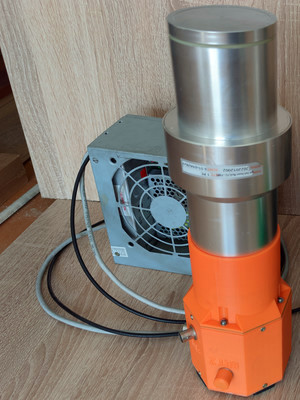
To monitor gamma (X-ray)-background at the ground level, we used the scintillation spectrometer based on the NaI(Tl) crystal. Model EPHP Series Sodium Iodide Scintillation Detector is a high efficiency detector featuring a NaI(TI) crystal with typical dimensions of ⌀ 61☓61 mm, included a photomultiplier tube (PMT), an internal magnetic/light shield, a high voltage power supply (HVPS), stabilization electronics, preamplifier and Wilkinson-type spectrometric analog-to-digital converter with high-capacity incremental memory.
The signal from PMTs is processed with a hybrid low power pre-amplifier plus a spectroscopic shaping amplifier system, the output pluses can be directly fed into the MCA, the low power consumption make the scintillation probe ideally suited for use with portable, battery operated multi-channel analyzer systems.
The precipitation gauge allows us to evaluate the intensity of precipitation in the form of rain and snow. The principle of its operation includes measuring of intensity of the scattered back radiation from the infrared source. The instrument is not calibrated and thus allows identifying only the presence of precipitations and qualitatively estimating their intensity.
An example of processing the event of increasing gamma radiation during precipitation described here (in Russian)
|
|
| |
|
|
| |
 |
The creation of the gamma detector is supported by the grant of Russian Science Foundation (project №18-77-10018) |
|
|